

Ad Hominem comes from the Latin for ‘to the person’. It happens when someone attacks the person making an argument instead of addressing the argument itself. The more emotional an argument gets the more likely it is to happen. The most common place Ad Hominem occurs is in debate and to nobody’s surprise…in political conversations where emotional temperatures run naturally high.
Educating yourself about Ad Hominem and being able to identify it is a crucial skill for life. It will help you to become a clearer thinker. It will help you to become a better communicator and expresser of your ideas. It will support your friendships, work relationships and romantic relationships.
An important point to understand is that not only is Ad Hominem rude, but it’s a manipulative thinking trap. When we use an Ad Hominem fallacy we stop learning, growing and solving problems.
So let’s break down the six different kinds of Ad Hominem.
- Name Calling – The most obvious and apparent form. For example…If someone were to have the position: “I think we should have stronger borders and deport dangerous illegal immigrants.” An Ad Hominem response would be…”you’re being anti-immigration.” or “You’re just ignorant.” It’s become all too common for folks to label someone a “fascist, racist, sexist, islamaphobic, or transphobic” as a way to shut them down and cancel them. It’s dismissive of the person and not the argument.
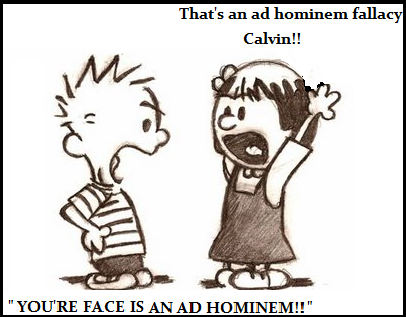
- Background Attacks – Another form of Ad Hominem is discrediting someone’s argument because of race or sex. This is called Background Attacks and it rejects the argument because of who they are rather than what they’re saying. For instance…”you can’t speak about immigration because you’re not an immigrant.” Or “You can’t speak about abortion because you’re not female.” “What could you possibly say about the experience of being black in America? You’re White!” Again, it discredits and disregards the person and not the argument.
- Bringing up unrelated facts about a person to make them look bad, despite the fact that it has little to do with the matter at hand. This one happens all the time. Imagine someone is speaking positively about Trumps tariffs and in response someone brings up the Stormy Daniels Scandal. The sentiment is something like “Well…he did this bad thing in the past and therefore cannot be trusted.” It attacks the person by focusing on an unrelated fact rather than the person’s perspective or argument that’s currently being discussed. Once again, it takes attention away from the current argument and attacks the person. This is common in couples therapy as well. I find that couples aren’t able to resolve an issue because it quickly gets tangential and redirected towards a past harm. For instance, I get upset that you’re not listening to me or being defensive. But the response is “Well, last month you were mean to me!” It takes the attention away from the current issue and leaves it unresolved by shifting focus towards an unrelated issue.
- Guilt by Association – Associations are tricky because they actually are relevant information. But they are not enough to attribute guilt. For instance…a relevant one would be Zohran Mamdami, the recently elected mayor of New York City. He has some association with Imam Siraj Wahhaj. Feel free to look that up on your own for what the controversy actually is. For our point, his associations are relevant for his politics and ability to lead. But associations are data points. They are not conclusions. There is no conclusion we can draw about Zohran’s ability to be Mayor just because of his association with the Imam. Again, his associations would be a relevant but nonetheless personal attack that would direct attention away from his policies and politics.
- Whataboutism – Attacking someone for being a hypocrite instead of addressing their argument. For example, when rich people with private planes speak about climate change. It would be easy to point out hypocrisy and say that the fact that they are rich and use private planes somehow means that what they are saying about climate change is invalid. It focus on the person and not the actual statement or argument being made about climate change itself. Everyone is hypocritical sometimes. But they can still be right about an issue even amidst the hypocrisy. But nobody wants to defend a hypocrite. We can see this clearly with TDS. Trump can’t possibly do anything right. Some people view him as so vile that they cannot possibly celebrate any victory he might achieve. The State of the Union Address is a good example of this. The Democrats were called out for refusing to applause or celebrate something positive simply because it was Trump.
- Genetic fallacy – Genetic fallacy entails dismissing or rejecting the idea because of its genesis. For example, If I were to say “the New York Times is leftist media propaganda and therefore cannot be trusted.” That view invalidates all information coming from the NYT. Just because the NYT is biased to the left, doesn’t mean that they cannot be right or be providing an important perspective that might differ than yours. Another great example that I’ve heard is that the constitution is invalid because the founders were slave owners. We cannot celebrate the founding of our country because of the history of slavery. We should have open borders because the US is founded on stolen land. Etc. Genetic fallacy attempts to invalidate the current argument of perspective because of history. Good arguments are good arguments…regardless of where they originate.

The important thing to understand is that Ad Hominem attacks are designed to trigger emotions. Emotions are easy to indulge. Logic is harder. Logic requires emotional regulation, it requires research, an open mind and positions that are well thought out. When you’re angry or feel defensive. Logic goes out the window. This is the trap that Ad Hominem brings. It’s designed to make you more emotional at the cost of reason. It plays to our tendency to process people rather than ideas, to judge personalities rather than policies. It also triggers our tribal orientation and can encourage polarized, us-vs-them thinking. It appeals to our base instincts and in that way is a serious impediment to real conversation, connection and community. It’s distorted thinking plain and simple. And that’s why it’s an incredibly serious logical fallacy.
Again, it’s not just rude…it’s a thinking trap. When people use Ad Hominem attacks, they redirect to an emotional appeal against the person themselves. For the person being attacked, It’s very easy to feel offended, confused and the need to defend themselves. This is horrible emotional manipulation because now the attacking person controlling the frame and getting you to react to them instead of moving the conversation or argument forward in a mutually reciprocal way. It’s exceptionally manipulative.
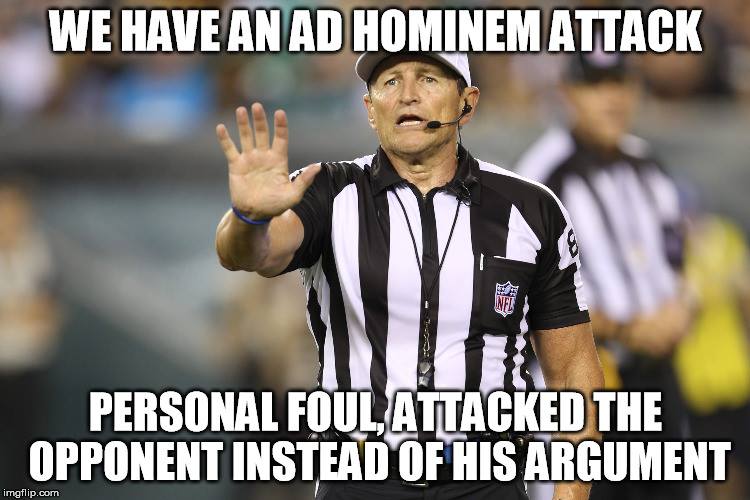
How do we deal with Ad Hominem attacks when they happen?
Firstly, be able to identify Ad Hominem fallacies. Start to notice when you do this (we all do). Notice when this comes up in the media that you watch whether it’s a movie or tv show or in how news is presented in media. Notice when people are represented (even in headlines) with name calling. “Crooked Hilary.” “Gavin Newsum.” “Deplorables.” Etc.
When in conflict or a debate…
- Ask whether the person is addressing the point being made. Or are they attacking the person instead?
- When using labels like fascist or racist, have they defined what those terms mean? Or have they proven that the term applies? This is another example of how to control the frame. If someone uses the word fascist without defining it or proving that it applies…then it becomes an accepted word to use in the conversation. Now on some level you have agreed that this term is usable. It’s a very sneaky tactic of getting someone to be on the defensive.
- Is there person bringing in irrelevant information? A good example of this in couples therapy is bringing in people who are not in the room. For example, “Well, Stacy agrees with me that you’re a defensive person.” Stacy is not in the room and cannot speak. It can make the other person feel ganged up on.
- Can you redirect the conversation? If someone keeps calling you names or using other Ad Hominem fallacies…can you bring the conversation back to the present moment, back to the pertinent information and what’s actually being discussed. For example, “I’d rather not focus on that…can we come back to the main point?” Or “I’d rather speak pragmatically about this policy rather than making character attacks.” Or “I’d rather discuss ideas.” Or asking a question like “I’m curious what you think about…” If redirecting is not possible then the conversation, in all likelihood, has a low chance of being productive. Feel free to walk away or draw a boundary at that point.
Ad Hominem poisons not just politics…it infects our thinking and our relationships. It can be as simple as disregarding a good idea at work because it came from someone that you do not like or respect. It can look like bringing up past mistakes rather than dealing with current issues.
Becoming a clearer thinking around Ad Hominem will allow you to:
- Evaluate ideas on their merits not on the people presenting them
- Have productive disagreements
- Learning from people you don’t initially like
- Focusing on solutions rather than personalities
- Collaborating better within community
As a final point: Social media makes all of this worse for a variety of reasons:
- Anonymous accounts with no accountability
- Character limits encourage quick emotional responses
- Algorythms reward outrage and conflict
- Echo chambers that amplify us-v-them thinking will inevitably lead to personal attacks
When posting online it’s helpful to ask yourself: Would I say this to their face? Does this move the conversation forward?