

False Dichotomy is a logical fallacy where only two options are presented when more options are actually available. It presents a situation as an either/or where the truth is much more nuanced and complicated.
Much of our politics encourages false dichotomy thinking. For example, you can be pro-choice or pro-life, pro-immigration or anti-immigration, pro-police or defund the police, climate change exists or it’s a hoax etc.
False dichotomies oversimplify exceptionally complicated issues. In this way it is a form of a straw man fallacy. It also has a lot of overlap with other major cognitive distortions such as overgeneralization, emotional reasoning and labeling which leads of course to polarized thinking. If you’re not with me then you must be against me. It puts people and issues into tribes. Me against you. Us against them (One of the three great untruths in Jonathan Haidt’s The Coddling of the American Mind). Here is a link to his wonderful book.
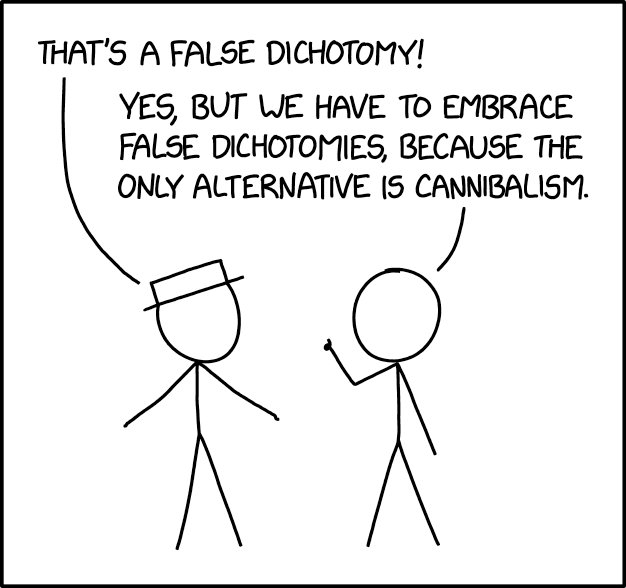
To illustrate the oversimplification of a false dichotomy more deeply, lets briefly delve into the abortion issue.
The framing of abortion from both sides is, more often than not, presented as a false dichotomy. The most common framing is either you’re pro-choice or pro-life. Pro-choice is the liberal position and pro-life is the conservative value. To prevent a group attribution error we must go deeper. Exactly how many liberal people or politicians are pro-choice? Is it necessary to be pro-choice to be a liberal? Can you be a pro-choice conservative?
Secondly, what does being pro-choice or pro-life actually mean?
Can I be pro-choice but only in cases of rape and incest? Can I be pro-life but only in cases of rape and incest? Can I be pro-choice but only in the first trimester and further in pregnancy only in cases that would risk the mother’s life?
Even in this framing I must present some statistics:
According to analysis of U.S. abortion data, approximately 1% of abortions are sought due to rape and less than .5% due to incest. (Cited from the Guttmacher Institute). The Charlotte Lozier Institute from 2021-2024 estimated that both rape and incest accounted for .4% of abortions. And of course these numbers are approximate due to data that results from voluntary surveys of women at abortion clinics and other complications with data collection. In the case of “saving the life of the mother”, we find similar statistics. Figures show 1.14% for life/physical health and 1.28% for mental health reasons. These together combine for 2.4% of abortions as “hard cases.”Most abortions are thus overwhelmingly selective and socio-economic reasons are the most common line of reasoning.
Thirdly, within the abortion debate, many present the framing of ”choosing life”, meaning that abortion should remain legal but we should attempt through other policies and funding to reduce how often it happens.
Fourthly, the abortion issue can be framed public policy standpoint/procedural issue. Should this be a federally protected right or is it a states rights issue? Many classic conservatives for instance, on principle, think that abortion should be determined by the individual states and not an issue for the federal government at all.
Lastly, control of the framing can occur from a moral standpoint. Simply presented,
The left says: Abortion is about access to medical care. The conservative counter-point being that this is de-humanizing language. Or many liberals frame abortion as an issue about female liberation, autonomy and sovereignty.
The right says: abortion is murder. Life is life. Humans are humans and are thus deserving of full human rights whether they are inside or outside of the womb. Abortion should thus be banned with few if any exceptions. Two wrongs do not make a right.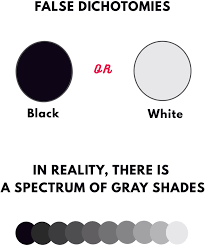
You can quickly see how incredibly complicated of an issue abortion actually is. To present a false dichotomy of being pro-choice or pro-life is incredibly dishonest and even emotionally manipulative as it sets up tribal thinking of us versus them, of a good side and an evil side.
Inviting in a more nuanced view of these complicated issues can cause enormous fear. Fear of being ostracized, judged, mis-seen, banished etc. It’s incredibly exposing to bring a dissenting opinion, especially in this age of cancel culture, call out culture and modern day witch hunts. Putting yourself up to that potential barrage takes courage. It involves differentiating, setting yourself apart, being willing to let go of highly held opinions, of potentially letting friendships and relationships go. It is actually a necessary stage of maturity. We all need to put a flag in the ground and be held to scrutiny. We need to be challenged. We need that to grow and evolve.
False dichotomies, just like all other cognitive distortions, prevent us from being able to think clearly and thus to mature. Presenting a false dichotomy makes the world simpler, more predictable and at least in the short term, psychologically safer. It’s more difficult to take on a more nuanced view. It’s challenging to put a flag in the ground and risk challenge. But this is exactly how we grow and refine our thinking.
In summary, a false dichotomy presents option A or option B. That’s it. That’s not a choice. It’s a trap. It’s a version of a stawman argument. There is either great outcome or terrible outcome. When presented this way, a steel man is presented for one side and a straw man for the other side. Making it seem like one choice is bad and the other is obviously better. You’re with us or against us. Either framing is a trap. Either framing is disingenuous. Practicing steel man argumentation is the best anecdote to false dichotomies. Here is a link to my blog about straw man v steel man arguments.
False dichotomies are appealing because of our very deep need to belong to a tribe, to a team. They simplify the world through a heuristic strategy. We conserve energy through simplifying complicated issues. We only exert the energy to be more nuanced when we absolutely have to. It takes effort and discipline. Also, we find friends and mates through our community. Risking that is incredibly scary and can come with great cost. Being ostracized and rejected is exile which basically means death. Swimming upstream from that impulse is quite difficult.
 To protect yourself from this thinking… simply ask:
“Is there a third option?”
“Is there a middle way?”
“Is the problem really this simple?”
“What’s a more nuanced way to look at this issue?”
The framing of a false dichotomy assumes that you must choose a side. You don’t. You can simply refuse the frame.