

Group Attribution Error can occur two ways:
- When we assume the behavior or beliefs of an individual reflects the belief of their entire group. For example, “That protestor was violent so all people in that group must be violent.”
- Assuming the groups decision represents individuals beliefs within that group. That country voted for that policy so every person must agree with it. For example, all Israeli’s agree with the war in Gaza.
Here are a few more extreme but unfortunately common examples:
“All Republicans are Nazis.”
“All Democrats are Communists.”
Simply put…conclusions can be drawn about who you are and how you think based on the group you belong to. Examples of these groups can be political, religious or various social and cultural groups. Liberal, Conservative, Progressive, Libertarian, Capitalist, Socialist. Christian, Muslim, Jew, Buddhist, Atheist, Humanist. White, Black, Person-of-Color, Feminist, Male, Female etc.
The difficulty of Group Attribution Error is that it plays on the necessary and useful tendency for pattern recognition. Groups are important and they can identify us in simplistic yet crucial ways. The error arises when we turn pattern recognition into stereotyping. Our brain craves simplicity, not more nuanced, complex realities. It’s just easier and simpler to lump people into categories. This is how we conserve energy and time. We tend to not think extensively unless we absolutely have to. This is natural and understandable. But it can lead us into Group Attribution Error.
This brings up Heuristics. A heuristic is a mental shortcut or rule of thumb that helps people make quick decisions or solve problems efficiently, often without perfect accuracy. Heuristics appeal more and more to people who are busy, stressed and overwhelmed. And it’s easy to fall into a heuristic judgment or stereotyping when we are emotionally overwhelmed, volatile or disregulated. Emotional reasoning encourages heuristics. Tribalism encourages heuristics. Social media encourages heuristics.
Again, the error isn’t in noticing patterns…the error is in assuming that the pattern is reflective of the whole. Group Attribution Error happens when selective truth is used without a more nuanced and honest context.
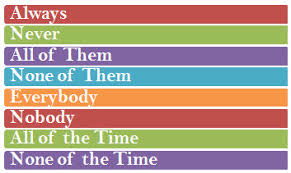
Let’s look at an some examples:
“All Democrats want open-borders.”
“Democrats are against all deportation.”
“Democrats support free healthcare for illegals.”
These statements are thrown around often by conservatives. It’s like candy. They give a quick dopamine hit. It can make a conservative feel intellectually superior or morally self-righteous. It can elevate themselves by poking fun, putting down and demonizing Democrats. All group competition is guilty of this. It can be fun, but it lacks nuance, maturity and honesty. We must train ourselves to go deeper and uncover more subtle layers of truth. In the case of these examples, as with most over-generalizations and stereotypes, it’s difficult to avoid this trap because there is some truth behind these claim. Democrats are more likely to agree with open-border policies than Republicans. BUT most democrats actually oppose open-border policies than support them. It is easier to over-generalize and say that Democrats support open-border policies just because they are more likely than Republicans to support them. But this is disingenuous. The details matter. For example:
What exact percentage of Democrats agree with open-border policies? What does “open-borders” actually mean? Can some Democrats agree with some aspects of open-border policies while opposing others?
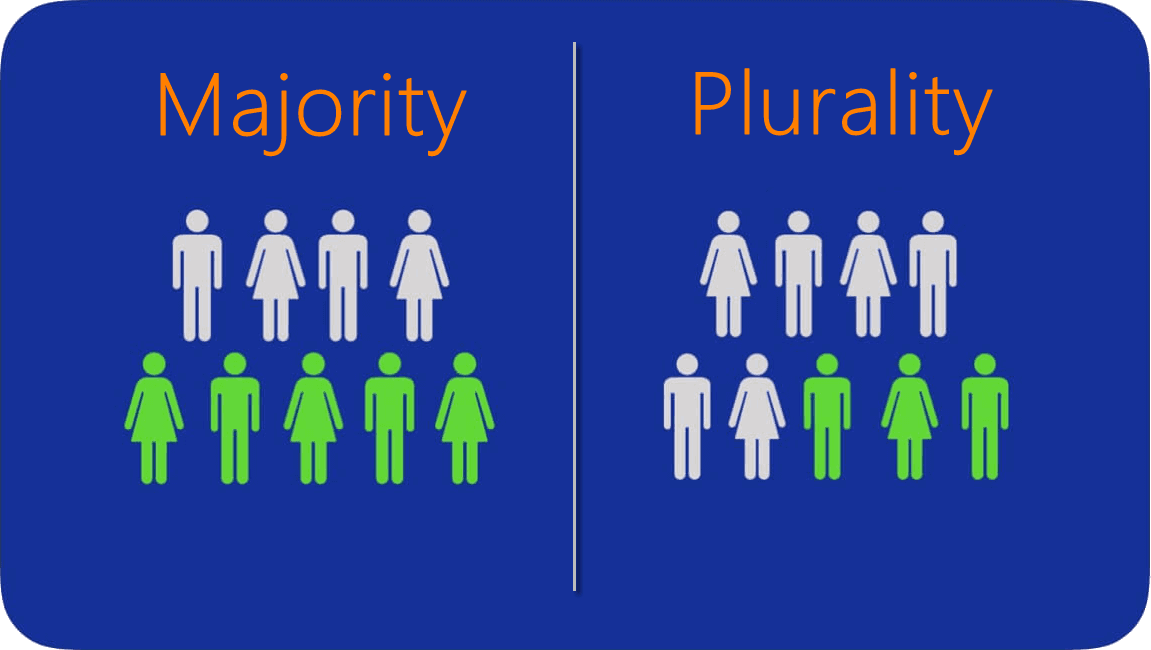
A helpful distinction to draw is the difference between the majority and a plurality. A majority would mean that over 50% must be achieved. A plurality does not require a majority but the largest pool. For instance, most U.S. elections operate on a plurality. Imagine an election between three candidates with 100 votes. A candidate may win with 45 votes (not the majority) because they received more than the other candidates who may have gotten 30 and 25 votes each.
It takes effort to be nuanced. It takes time and energy. Being nuanced and honest is more difficult to execute and it’s certainly harder to get attention that way (especially online). You get more attention more easily by playing to peoples biases and tribal associations.
How do you protect your mind from this?
We must ask ourselves when consuming information:
Is it healthy information or is it junk food?
What percentage of the group does this statement apply to? All? Majority? Plurality?
Investigate the information yourself. Ask AI…what percentage of Democrats support open-borders?
Is the claim backed by credible sources? Or is it cherry picked info?
Train your brain to catch this. Have some humility when speaking about issues that you haven’t researched. It’s fine to have a bias but do some digging, apply some effort to understanding and appreciating the complexities to an issue.
Most importantly, take responsibility for your projections on to other people. Just because someone is a Democrat, it doesn’t mean that they will agree or disagree with you on a particular issue.
Treat people as individuals and not just as representatives of groups.